
Introduction
Have you ever wondered how others perceive you and what impact your actions have on your team?
Self-awareness is one of the most critical leadership skills, yet it’s often overlooked. In my coaching work, I see this challenge at all levels of leadership—from first-time managers to senior executives.
Regardless of experience, many leaders share the same concerns:
“I’m not sure how others see me.”
“I admire my colleague—he seems so much more confident than I am.”
“If I ask my team for feedback, will I come across as weak?”
These reflections highlight the importance of self-awareness, not just as a personal skill but as a strategic tool for leadership success.
Why Self-Awareness is a Game-Changer for Leaders
Self-awareness is the ability to understand your own strengths, limitations, and emotional triggers, while also recognizing how others perceive and respond to you.
? Key Statistics on Self-Awareness in Leadership:
- ✅ Only 10-15% of people are truly self-aware (Eurich, 2018).
- ✅ Leaders with high self-awareness are 32% more effective in managing teams (Harvard Business Review).
Yet, many leaders—even those at the executive level—struggle with self-awareness. The challenge isn’t experience, but the inability to see oneself objectively and understand one’s impact on others.
Leaders who develop strong self-awareness:
✔ Make better decisions
✔ Build stronger relationships
✔ Lead with authenticity and impact
The 5 Biggest Obstacles to Self-Awareness
Many leaders think they understand themselves well, but several hidden obstacles often block true self-awareness.
? We overestimate our self-awareness → We think we know ourselves, but we often ignore how we affect others.
? We ask the wrong questions → Instead of asking, “Why am I insecure?”, ask, “What can I do to increase my confidence?”.
? We receive filtered feedback → Team members hesitate to give honest input, making it harder to gain an accurate external perspective.
? We overestimate our listening skills → Studies show that 80% of the time, we are thinking about what to say next rather than truly listening.
? Reflection without action leads nowhere → Self-awareness should drive growth and behavior change, not just self-analysis.
“I often hear leaders say, ‘I always listen to my team.’ But in reality, they’re just waiting for their turn to speak.”
The 4 Self-Awareness Archetypes
According to Tasha Eurich, self-awareness is built on two dimensions:
✔ Internal self-awareness (knowing who you are and what drives you)
✔ External self-awareness (understanding how others perceive and respond to you)
When these two dimensions intersect, they create four distinct self-awareness profiles, each with its own strengths and challenges. Understanding where you fall can help you develop a more balanced and effective leadership style.
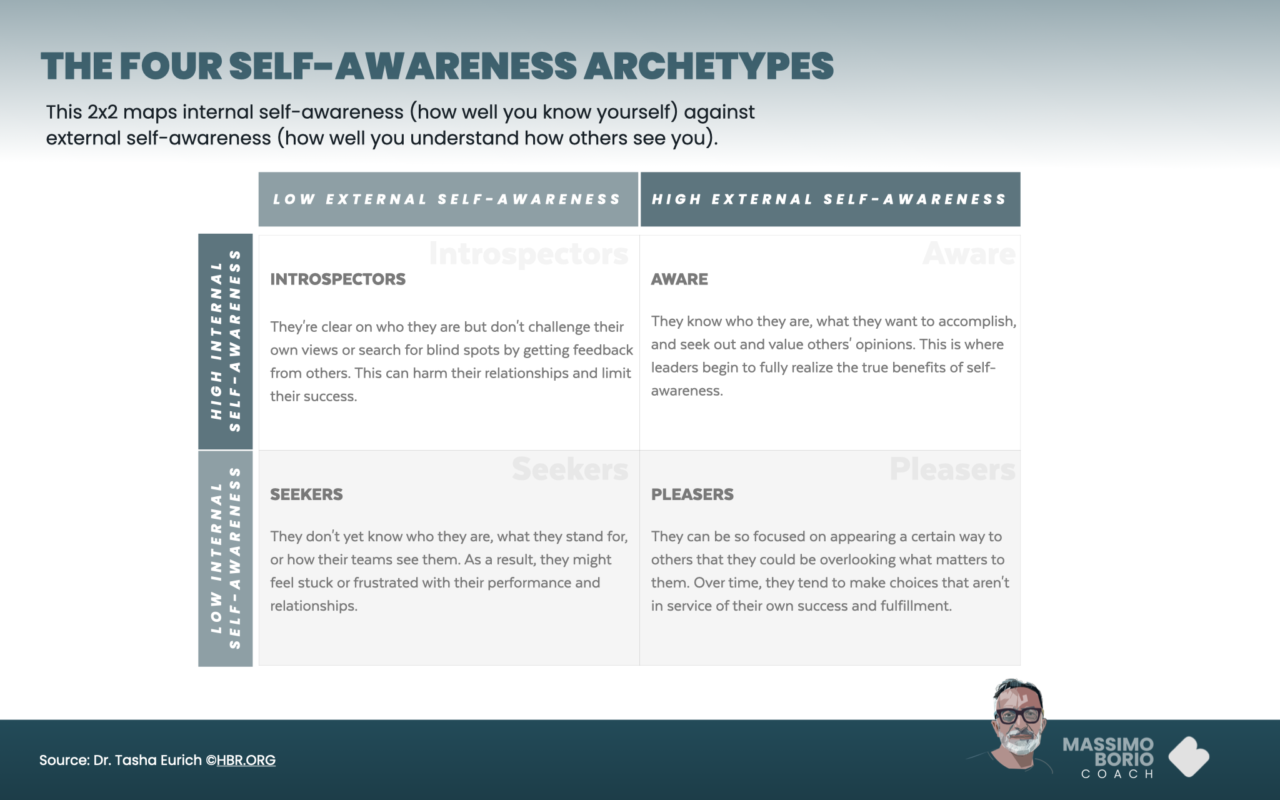
? Introspectors → They know themselves well but ignore external feedback. (Solution: Seek honest external perspectives.)
? Seekers → They lack clarity on who they are and how others see them. (Solution: Engage in structured reflection and ask for feedback.)
? Pleasers → They rely too much on external validation. (Solution: Balance external feedback with personal values.)
? Aware Leaders → They combine deep self-knowledge with openness to feedback. (The ultimate leadership goal.)
Practical Strategies to Improve Self-Awareness
? 1. Daily Self-Check-In
Spend 5-10 minutes at the end of the day to reflect:
- What went well today?
- Where did I struggle?
- How can I handle similar situations differently in the future?
? 2. Create a Safe Space for Feedback
- Ask specific and constructive feedback from colleagues and direct reports.
- Example: “What’s one thing I could improve in my team meetings?”
? 3. Balance Reflection with Action
- Self-awareness should lead to action.
- Identify patterns, experiment with small behavior changes, and observe the results.
? 4. Use 360-Degree Feedback
- Structured feedback tools help compare internal perception with external reality.
? 5. Adopt a Growth Mindset
- The best leaders never stop learning and adapting.
Why Self-Awareness is a Leadership Skill at All Levels
Self-awareness is not just for emerging leaders—it’s equally critical for experienced executives.
As leaders rise through the ranks, it becomes harder to receive honest feedback because people may hesitate to speak candidly to senior executives.
Developing self-awareness is an ongoing process that requires balancing introspection and external feedback. Leaders who succeed at this:
✔ Create stronger teams
✔ Make better decisions
✔ Lead with greater impact
Why not take it to the next level?
Self-awareness is not just a leadership skill—it’s the foundation for making better decisions, building trust, and leading with authenticity.
Book a free, no-obligation, 30-minute session with me to explore how self-awareness, emotional intelligence, and strategic feedback can help you unlock your full leadership potential, strengthen your impact, and create a more engaged and high-performing team.
Wishing you a week of clarity and growth,
Massimo ?
Further Reading
How Feedback and Appreciation Transform Leadership